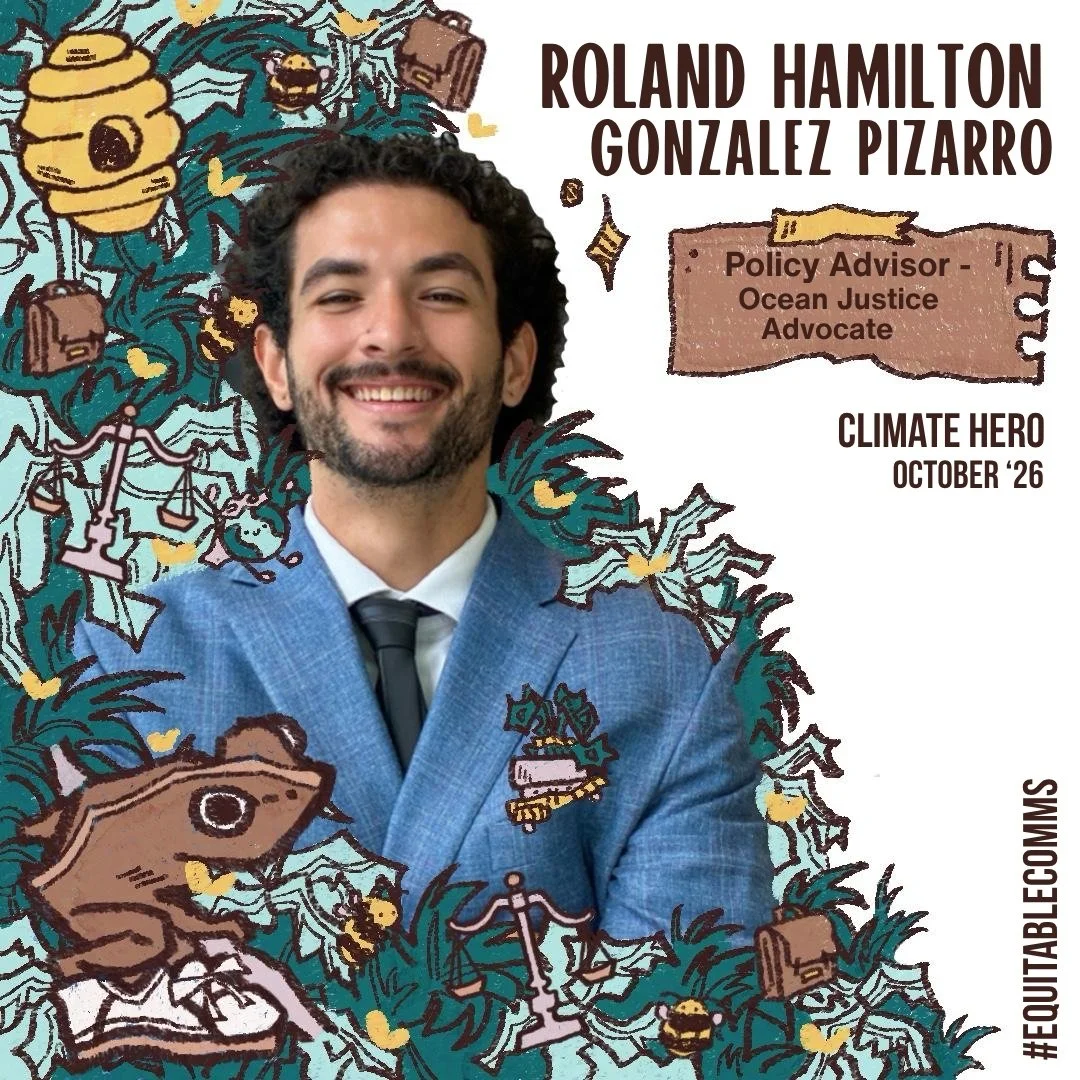
Roland's tenacity and drive to advance ocean-climate policy solutions rooted in equity give us so much hope and inspiration. That's why we're excited to continue our Climate Heroes series by highlighting and celebrating Roland Hamilton Gonzalez Pizarro’s leadership in ocean-climate policy.
Advising state and federal policymakers in the U.S. has been a core characteristic of Roland's work, alongside his ability to quickly and securely pivot to advance advocacy strategies with non-profits and individual leaders. This, coupled with Roland’s vast expertise in foreign affairs and environmental policy, makes him a south-after mind in pursuit of structural disruption and change to advance equitable, effective solutions. I’ve seen his drive to see negotiation, climate diplomacy, and international governance work for communities, nations, and ecosystems firsthand, as he's sat alongside delegates from around the world to find inroads on effective policy solutions that protect marine ecosystems, promote climate resilience, and advance global environmental justice.
In this field, it's easy to be in a constant mindset of lobbying, advocating, and pursuing the next meeting to meet legislative calendars. Yet Roland ensures he stays grounded in his love for nature, alongside his pursuit of justice and love for his community in Puerto Rico, where he was born.
His affinity for making people laugh and dance is something I won't soon forget, as I recall ocean advocates dancing to his beat and his leadership during a Fiesta Azul dance party.
We asked Roland about his work and commitment to ocean justice. Read his Q & A below!
In your own words: What does being an ocean-climate hero mean to you?
“For me, being an ocean-climate hero isn't about heroics. It's about showing up, again and again, for the places and people too often left out of the rooms where decisions get made.
I grew up with the ocean as a constant presence. In Puerto Rico, the sea is not scenery. It is livelihood, culture, and protection all at once. That closeness taught me early that ocean health and human dignity are the same fight. When a coastline erodes, or plastic chokes a reef, it is coastal and island communities, often Black and brown, often working class, who feel it first and recover last.
At Azul, I carried that conviction into five sessions of the UN global plastics treaty negotiations as a civil society negotiator, working to keep community voices and environmental justice at the center of a process that could easily have been captured by narrower interests. I kept going back because someone has to insist that the people most affected by the plastics crisis are treated as authors of the solution, not an afterthought.
Ultimately, this work is collective. The victories that matter are built by organizers, scientists, fishers, youth advocates, and negotiators who refuse to give up on each other. The ocean has given my communities everything, and fighting for it is how I try to give something back.”
What actions do you take to protect our Mother Earth and communities? What does climate justice mean to you?
“My work happens where the rules that shape our environment get made. I spent years on ocean and water governance, including five sessions of the UN plastics treaty negotiations as a civil society negotiator, pushing to keep frontline communities at the center of the outcome. On Capitol Hill, I staffed Members of Congress on energy and environmental issues, and in the Puerto Rico Senate I worked on disaster recovery after our communities were left to rebuild on their own.
Now I am carrying that into the law. Justice is won not only in negotiating halls and committee rooms but also in the systems that decide who gets protected and who gets overlooked. Through my work in the courts and in a tax clinic, I engage with how policy holds actors accountable for their environmental impact and how legal systems can protect vulnerable communities. Protecting the earth is not only advocacy. It is a daily practice of showing up, translating between the technical and the human, and making sure the people most affected are heard in Spanish and English alike.
Climate justice means recognizing that the communities who did the least to cause this crisis are carrying its heaviest weight. Coastal and island communities, Black and brown communities, working-class communities. They feel the storms, the erosion, and the pollution first, and they wait longest for relief.
For me, it is personal. Puerto Rico taught me what it looks like when a place is treated as expendable.
Is there a word or phrase you think of to keep you inspired on the hard days?
“ ‘Al que a buen árbol se arrima, buena sombra lo cobija.’
It is a saying that my mom instilled in me. It means that whoever draws close to a good tree is sheltered by good shade. To me it is a reminder that if you do good work, surround yourself with good people, and lead with good intentions, that energy comes back to you. On the hard days, it keeps me rooted. The fight for our ocean and our communities is long, but you are never doing it alone, and the good you put into the world has a way of returning.”
Who do you believe embodies climate hero values?
The climate heroes I think of are rarely the ones with the biggest platforms. They are the frontline communities themselves. The coastal and island families, the fishers, the youth, the working-class neighborhoods who face the storms, the erosion, and the pollution first and still refuse to give up on their home. They organize, they rebuild, and they demand a seat at the table, often without recognition or resources. They embody climate hero values because they carry the heaviest weight of this crisis and still lead with dignity, urgency, and care for one another. Everything I do is in service to them.
About Climate Heroes: This summer, our Equitable Comms team launched a new series called Climate Heroes. Through this series, our goal is to highlight ocean and climate justice leaders and advocates who dedicate their lives to protecting our planet and communities. Whether working locally, nationally, or globally, these individuals are changemakers who challenge the status quo and ask us to imagine and fight for a better world for our communities.